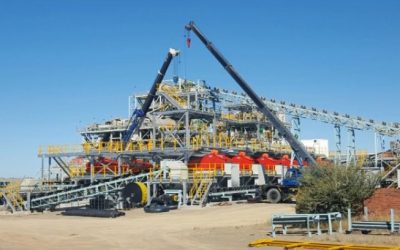
463 Bucket Refurbishment Project – completed by GHAAP and SOLHAR – 2024

463 Bucket Refurbishment Project – completed by GHAAP and SOLHAR – 2024

463 Bucket Refurbishment

Project

Ruark from GHAAP Engineering and Field Services approached SOLHAR to assist in this refurbishing project for his client. GHAAP operates from Danielskuil area and we brought the bucket to Kimberley to repair.  Below you can see the process of this refurbishment. Thank you Ruark and the team for your countless hours of work you put in to complete this job.

Ruark Bothma - GHAAP Engineering & Field Services-Email Signature
SOLHAR LOGO NEW 2024 Optimized

Here the SOLHAR team is seen stripping off the 463 Dump Truck 's bucket from it's chassey:

Stripping of 463 dump truck bucket from chassy.

Having to remove the bucket from the dump truck, we needed to lift the bucket by means of a crane and placed it on a lowbed for transport:

After removing bucket from dump truck bucket need to be lifted and place on lowbed by means of a crane.

Watch the videos of loading the bin:

GHAAP Engineering & Field Services Logo2

Placing the 463 Loader Bucket on the lowbed for transport to SOLHAR in Kimberley:

SOLHAR Placing 463 loader bucket with crane on lowbed for transport to Kimberley

Abnormal load on its way to Kimberley:

Abnormal load on its way to SOLHAR in Kimberley

Bucket arrives at SOLHAR to start refurbishment process:

Bucket arrives at SOLHAR to start refurbishment

Our specialized team starts to identify high wear areas on the bucket:

Identifying high wear areas on bucket

Assessment of areas to be removed and replaced:

Assessment of areas to removed and replaced.

Lifting 20mm liner 500 brinell hardness over the side of a truck to be welded in position. (Ruark does not work without his dog):

Lifting 20mm liner 500 brinell hardness over side of truck to be welded in position.

Due to the size and weight of the loader bucket, a tandem lift was required to turn bucket to accommodate welding:

Due to the size and weight of the loader bucket a tandem lift was required to turn bucket to accommodate welding.
Solhar Energy Solutions & Engineering - LOGO 2022

Here we are welding the new liners onto the inside of the bucket:

Welding of new liners on to inside of bucket

Our job is complete on the inside! New liners for wear at the bottom of the bucket:

Job completed on the inside. New liners for wear at bottom of bucket.

New liners for both sides of the bucket:

New liners for both sides of bucket

Sandblasting and completing the paint on the outside of the bucket:

Sandblast & paint complete outside of bucket.

Here we are making this old bucket look pretty with a full refurbishment:

Making the bucket look pretty.

The completed bucket refurbishment job delivered back to the mine and on time. Well done SOLHAR and GHAAP for this combined effort!

Completed job delivered on time back to the mine.

What is structural steel used for?

What is structural steel used for?

Structural steel is primarily used for construction purposes, but it can also be found throughout the automobile & energy infrastructure industries. There may even be instances where structural steel is used to build various machinery, equipment storage tanks, tools, household appliances & for food and beverage packaging.

Since this blog is focusing primarily on the applications of structural steel in the construction industry, we will touch upon that a bit more here.  What specific structures are built with structural steel?
• High rise buildings
• Residential buildings
• Industrial pole barns or sheds
• Bridges
• Parking garages

What is Structural Steel Used for - Image 01 - SOLHAR Structural Steel
What is Structural Steel Used for - Image 02 - SOLHAR Structural Steel
What is Structural Steel Used for - Image 03 - SOLHAR Structural Steel

In general, structural steel is a preferred material of engineers, designers, architects and contractors throughout the construction industry. Its strength is unmatched which makes it ideal for the building of the structures mentioned above.

However, the material itself must also be able to handle tension, be easy to work with, ductile and, of course, be affordable too. Structural steel possesses all of these qualities so you can see how it has become a popular material choice for structures of all kinds.
Another important quality of structural steel is machinability.

You may be wondering what this means? Well, machinability is defined as “the ease with which a metal can be cut (machined) permitting the removal of the material with a satisfactory finish at low cost.”
This quality is important because it allows for structural steel to be made into many unique shapes.

SOLHAR Botswana – Stage Tank for Water Storage and to Pump Water

Our client in Botswana requested us to come up with a solution for a stage tank to be able to store and pump water out of the pit area. Because of the depth of the pit, it is not feasible to pump water all the way up and out. The pumps required to do this is not cost effective. To be able to use smaller pumps the water needs to be pump in stages i.e. halfway up and then the last bit out of the pit area.

read more

Wi-Fi Tower Installation at Vermeulens New Development by SOLHAR

Problem: We were request by VERMEULENS and TRAMWAY / JENNEY INTERNET to install a WIFI tower on the new site.
Constraints that were facing us getting the right position and hight to be able to receive a strong signal. Problem is the best position was right in the path of the roadway for the delivery vehicles, we had to improvise to achieve the same result.
Decision was made to fix the WIFI tower to the side of the building out of the path of the delivery vehicles and in the best position possible.

read more
How is structural steel made and how is it different than regular steel?

How is structural steel made and how is it different than regular steel?

Before we get into the specifics of structural steel, let’s just discuss how steel in general is made. There are two ways that steel can be made a) working with raw materials or b) recycling used materials.

We will touch on raw materials first. 

The first step in making steel from raw materials is to extract iron from iron ore. 

How is structural steel made and how is it different than regular steel - Image 01 - SOLHAR Structural Steel
How is structural steel made and how is it different than regular steel - Image 02 - SOLHAR Structural Steel

The iron ore is extracted from taconite by first grinding it into small particles and then using magnets to pull out the iron ore.  This leads up to the next step in the process of making iron.  The iron ore is actually quite weak and needs carbon to provide it with strength. When working with raw materials, a blast furnace is used to heat iron ore and carbon will be added to the mixture.

How is structural steel made and how is it different than regular steel - Image 03 - SOLHAR Structural Steel

Side note- Do you guys remember Henry Bessemer from history class? He’s the guy who created the blast furnace sometime in the mid 1850s. Neat, huh?

How is structural steel made and how is it different than regular steel - Image 04 - SOLHAR Structural Steel

You may be wondering what the source of carbon is. Typically, it’s a form of coal high in carbon called coke.  This coke is mixed with iron ore under high  temperatures. It’s the heat that creates the chemical reaction responsible for the carbons from coke bonding to the oxygens from iron oxides. This is called reduction.

At this point the material will contain too much carbon for the product to be considered steel. It’s the reduction of carbon that helps to provide the material with strength. So, the mixture will be heated and cooled strategically until the carbon content is less than 2.1% of the product’s weight. Structural steel must have a carbon content between 0.05-0.25%.

Structural steel has a carbon content between 0.05-0.25%. This is what makes it stand out among other types of steel.  

Keep in mind, there are many varying compositions in steel, all designed for specific purposes. It just so happens that low carbon steel is the best for construction (and known as structural steel) because it has sufficient strength but is also more malleable than high carbon steel would be.
Is anyone interested in hearing about the other way to make structural steel from recycled material?
If not, just skip over this part.

How is structural steel made and how is it different than regular steel - Image 05 - SOLHAR Structural Steel

When working with scrap metal, an Electric Arc Furnace (EAF) will be used.  Essentially, a crane will lift the scrap steel into the furnace. Once the furnace is full, the lid will be closed. This lid is important because it holds electrodes charged with an electric current which create large amounts of heat capable of melting the scrap metal down.

This is where certain alloys may be added to the metal in order to obtain various grades of steel.

How is structural steel made and how is it different than regular steel - Image 06 - SOLHAR Structural Steel

No Results Found

The page you requested could not be found. Try refining your search, or use the navigation above to locate the post.

What is structural steel?

What is structural steel?

Structural steel is a category of steel used for construction purposes, known for its strength and durability. It's often used in the construction of buildings, bridges, and other large structures due to its ability to support heavy loads. The properties of structural steel can be customized through heat treatment and alloying, allowing it to meet specific engineering requirements.

Structural steel is a carbon based metal, available in many grades, that is used all over the world in the construction industry. To be considered structural steel in South Africa, the product must meet industry standards set forth.

So, how is structural steel different from non-structural steel? Well, it comes down to the composition of the product. And, to understand this, we must first understand what steel itself is. 

Steel is an alloy made out of iron and carbon. Most of us are familiar with these elements, but may not have known that it’s rare to find them existing in their pure forms. 

So, how is steel made and how is it different from structural steel? Let’s jump to the next section to find out. 

SOLHAR-Service---Structural-Steel


SOLHAR-Service—Structural-Steel

Structural steel is used in a wide range of applications, including:

Building frames and structures, Bridges, High-rise buildings, Warehouses, Airplane hangars, Educational facilities, Stadiums, Roads and highways.

Conclusion

In summary, structural steel is a versatile and widely used material in the construction industry. Its unique combination of strength, ductility, and corrosion resistance makes it an ideal choice for a variety of applications. Understanding the composition, types, and properties of structural steel is essential for architects, engineers, and builders to design and construct safe, durable, and efficient structures.

No Results Found

The page you requested could not be found. Try refining your search, or use the navigation above to locate the post.